How Brix, Heat Transfer, and Pump Load Interact in Thick Puree Production
In thick fruit puree production, Brix is never just a concentration number. As apple, pear, apricot, mango, or mixed fruit puree moves toward target solids, the plant also sees changes in viscosity, heat transfer, pump load, screen behavior, and batch-to-batch texture.
For a process manager, the challenge is practical: reach the specification without pushing evaporators, tubular heat exchangers, pumps, finishers, or holding circuits into unstable operation.
That is where enzyme-supported puree processing can help. As an enzyme supplier for fruit puree processing, VelvetYield supports plants that need smoother flow behavior, better yield recovery, cleaner filtration, and more repeatable texture while protecting the gentle, nourishing profile expected in baby food and fruit puree applications.
Why Brix Raises the Engineering Pressure
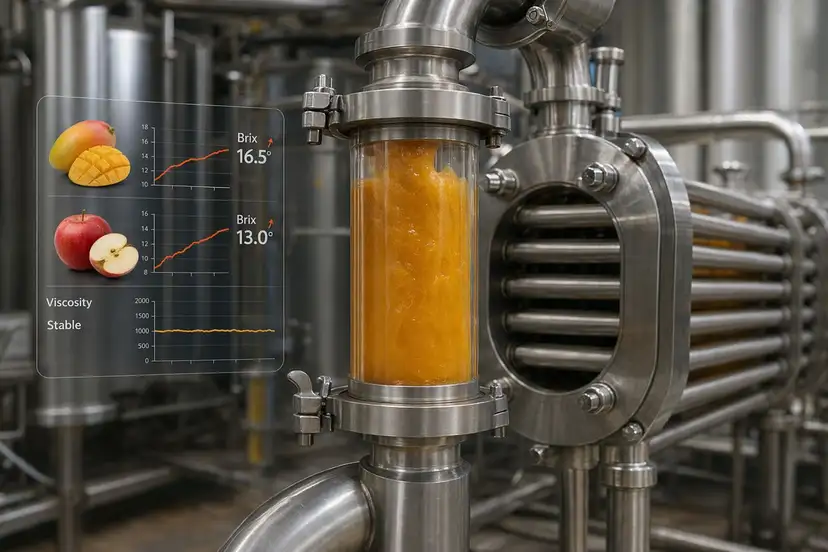
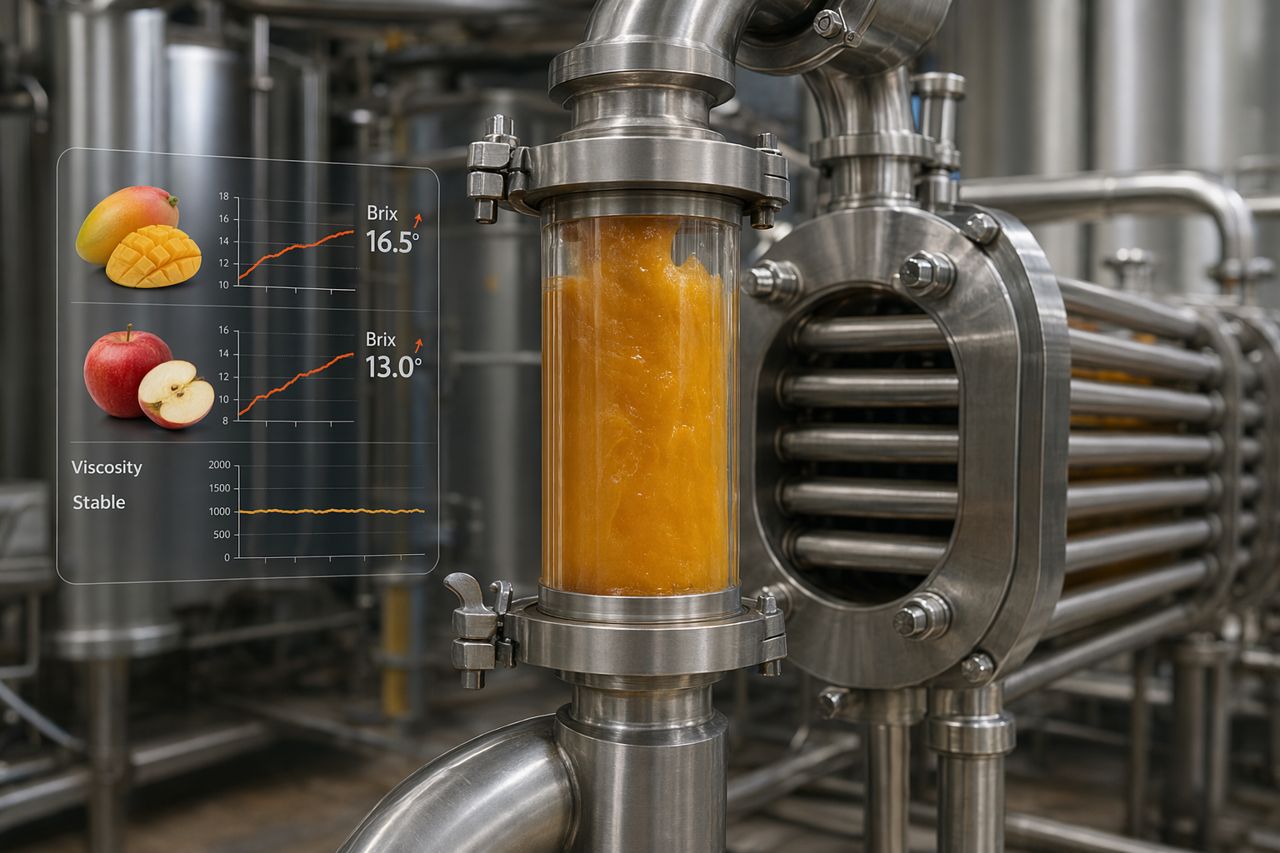
As soluble solids increase, the puree carries less free water and more concentrated fruit solids. At the same time, native pectin, cell wall fragments, pulp particles, and insoluble material can form a stronger internal network.
The result is often visible on the plant floor:
- Higher apparent viscosity at the same target Brix
- Slower flow through pipes, screens, and heat exchangers
- Increased pump load and pressure variation
- Reduced heat transfer efficiency
- Longer concentration time
- More risk of localized overheating or texture damage
- Greater batch-to-batch variation after seasonal fruit changes
A puree that looks acceptable in the balance tank can become difficult once concentration begins. Small differences in fruit maturity, pectin structure, particle size, or pre-treatment can multiply as solids rise.
Heat Transfer Depends on More Than Temperature
Operators often adjust temperature, flow rate, or hold time when thick puree stops behaving. These levers matter, but they do not always solve the root cause.
Heat transfer in thick puree is limited by how well the product moves across the heat exchange surface. If viscosity rises sharply, the boundary layer becomes less efficient. The heat exchanger may still be hot, but the product does not carry heat evenly through the stream.
Common symptoms include:
- Wider spread between heating medium behavior and product response
- Hot spots near surfaces and cooler zones in the moving puree
- Longer time to reach evaporation or pasteurization targets
- More frequent fouling or cleaning interruptions
- Texture shifts from overworked pulp
In baby food and puree lines, these issues are especially sensitive because the finished product must remain smooth, safe, and consistent while meeting label and sensory expectations.
Pump Load Is a Process Signal, Not Just a Maintenance Issue
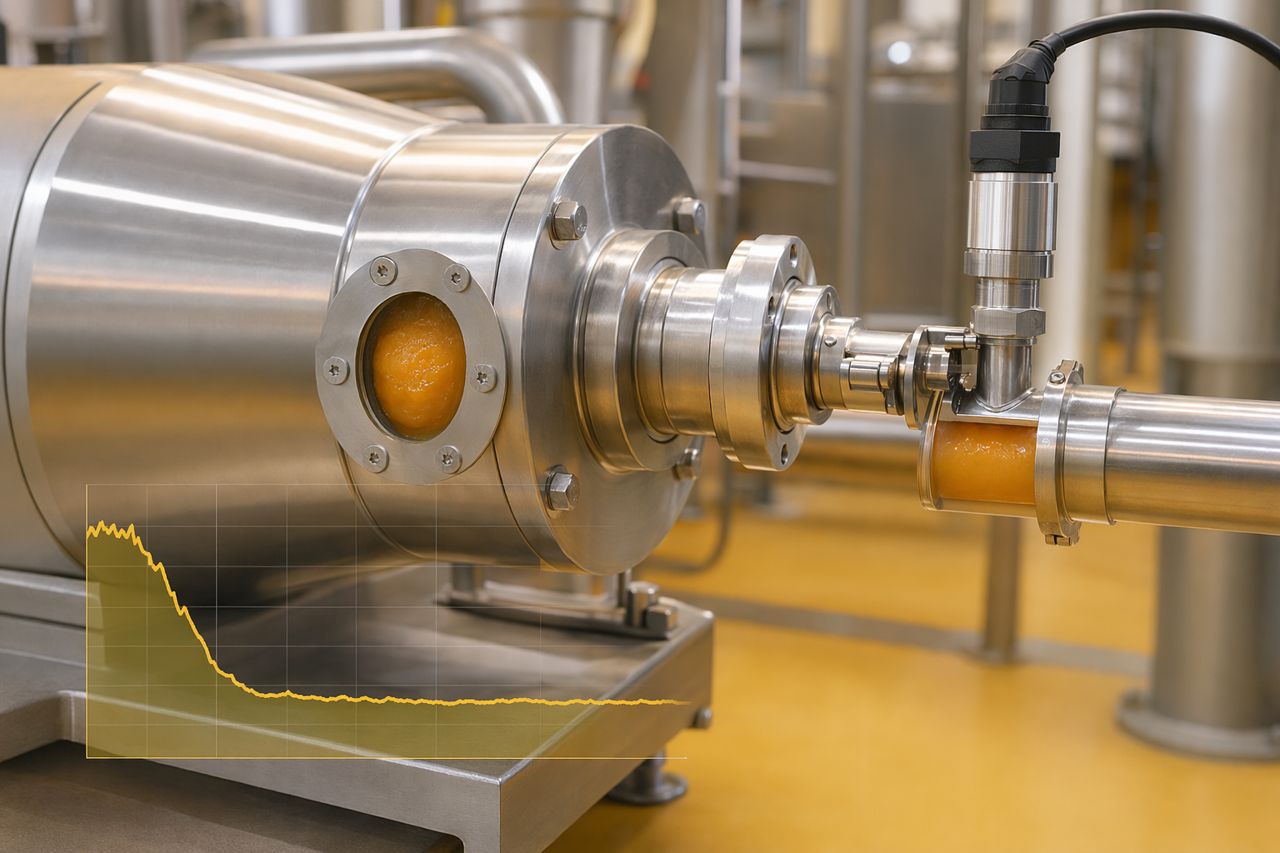
Rising pump load is often treated as a mechanical concern. In thick puree production, it is also a process signal.
If amperage, discharge pressure, or pulsation changes from batch to batch at the same nominal Brix, the puree matrix is changing. The pump may be working against pectin-driven viscosity, larger suspended particles, entrained air, inconsistent milling, or incomplete fruit breakdown.
That creates downstream effects:
- Less stable flow to the evaporator
- Variable residence time in thermal sections
- Increased shear exposure
- Screen blinding or finisher overload
- More operator intervention to hold specification
When the process depends on manual adjustment, every new fruit lot becomes a risk. Enzyme treatment helps move the operation toward a more predictable flow window before the puree reaches the most equipment-limited steps.
Where Enzymes Fit in the Puree Line
VelvetYield enzyme solutions are used to modify fruit structure in a controlled way before the highest-load stages of production. The goal is not to thin puree indiscriminately. The goal is to tune the matrix so it flows, heats, presses, and filters more consistently while preserving the target texture.
Depending on fruit type and process design, enzyme treatment may support:
- Improved mash breakdown before finishing
- Higher juice or puree recovery from fruit solids
- Lower viscosity before concentration
- Smoother flow through heat exchangers
- Reduced pressure fluctuation across screens and filters
- More stable texture after thermal treatment
- Better batch repeatability across seasonal raw material variation
For puree and baby food plants, the best enzyme program is defined around the equipment train, not only the fruit type. VelvetYield evaluates where viscosity forms, where yield is lost, where screens blind, and where pump load starts to limit throughput.
A Practical Control Map for Thick Puree
When Brix, heat transfer, and pump load interact, the most useful data is usually already present in the plant. VelvetYield recommends building a control map around the points where the puree changes behavior.
Track before concentration
- Fruit variety and maturity profile
- Mash temperature window
- Holding time before finishing
- Particle size after milling or pulping
- Enzyme addition point and mixing quality
- Viscosity trend before evaporation
Track through heating and evaporation
- Feed consistency to the heat exchanger
- Inlet and outlet temperature stability
- Pump pressure trend
- Pump load trend
- Flow stability during concentration
- Steam response or energy demand pattern
- Fouling tendency and cleaning frequency
Track after concentration
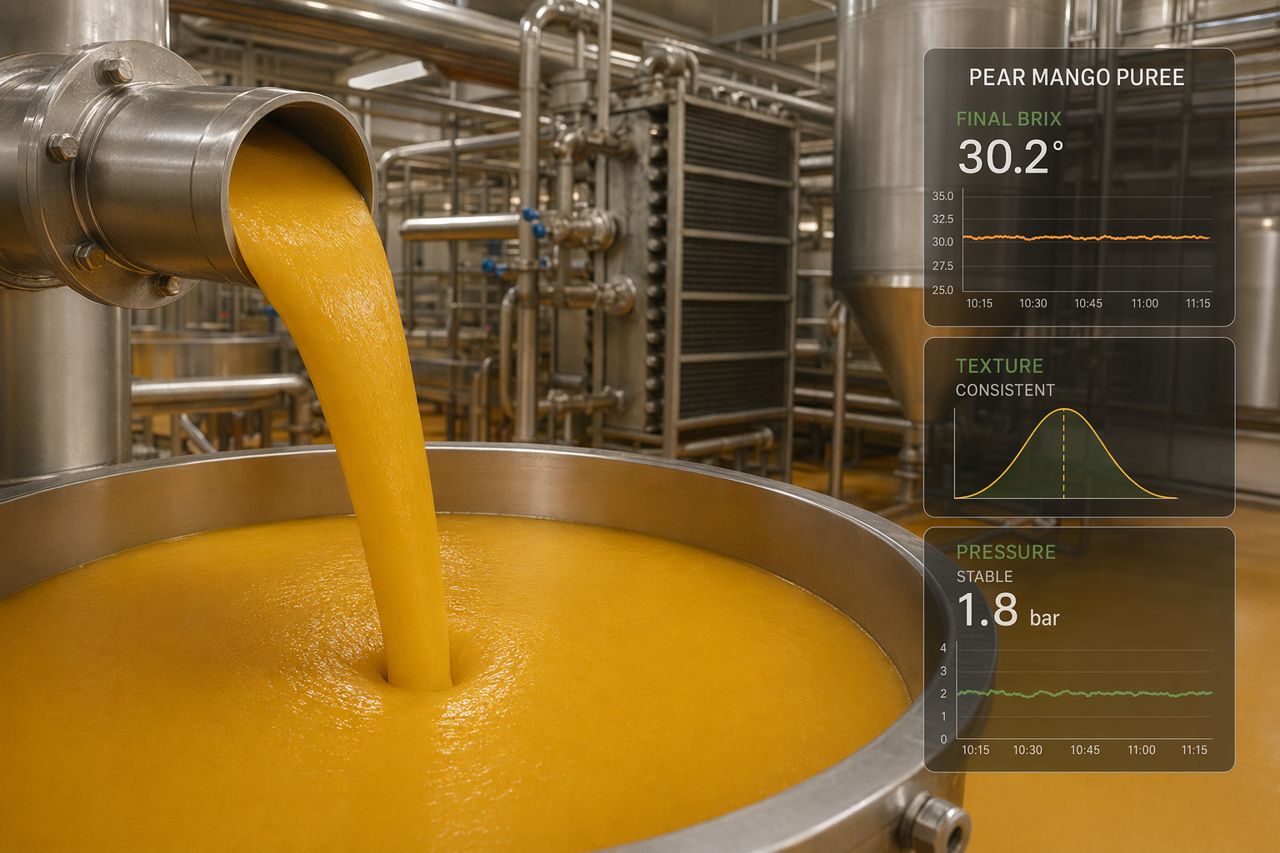
- Final Brix stability
- Finished puree viscosity
- Texture after cooling
- Screen or deaeration behavior
- Fill consistency
- Rework or downgrade rate
The value is in comparing these signals across fruit lots and batches. A stable enzyme program should make the operating window easier to hold, not harder to interpret.
Why Over-Correction Can Create New Problems
It can be tempting to drive viscosity as low as possible. In puree and baby food production, that is rarely the right target.
Too much structural breakdown can reduce body, create separation risk, or move the finished product away from the desired spoonable texture. Too little treatment leaves the plant fighting pump load and poor heat transfer.
The better target is a controlled viscosity profile:
- Low enough to transfer heat efficiently
- Stable enough to pump without pressure spikes
- Structured enough to deliver the desired mouthfeel
- Predictable enough to support filling and packaging
VelvetYield helps define that middle ground through process review, trial planning, and enzyme selection matched to fruit matrix and equipment constraints.
What Better Performance Looks Like
A well-tuned puree process does not feel dramatic. It feels calmer.
Operators see fewer sudden pressure changes. Evaporators reach target solids with less struggle. Heat exchangers respond more predictably. Finishers and screens remain usable for longer production intervals. The finished puree holds the intended texture with fewer corrective actions.
Typical plant-floor value includes:
- Better pressing or puree extraction yield
- Lower viscosity at critical transfer points
- More consistent heat transfer behavior
- Reduced pump stress and pressure variation
- Improved filtration or finishing performance
- More reliable final texture at target Brix
- Fewer batch deviations linked to raw material variability
For process managers, these gains translate into throughput protection, reduced rework, easier scheduling, and a more controlled path to specification.
How VelvetYield Supports Trial Work
VelvetYield works with fruit puree and baby food plants to design enzyme trials that fit real production constraints. The focus is on measurable process outcomes, not lab language that does not translate to the line.
A typical support discussion covers:
- Fruit type, blend strategy, and seasonal variation
- Current Brix targets and viscosity pain points
- Existing milling, heating, holding, and finishing steps
- Pump load, pressure, and flow stability concerns
- Yield loss points and screen or filter behavior
- Finished texture requirements and quality limits
- Trial batch size, sampling points, and success criteria
From there, VelvetYield recommends an enzyme approach and dosing strategy suitable for the process window, with attention to food safety, handling, and repeatability.
The Engineering Takeaway
In thick puree production, Brix, heat transfer, and pump load are linked. When puree structure is not controlled, concentration becomes harder, energy transfer becomes less efficient, and equipment limits appear earlier than expected.
Enzyme-supported processing gives plants a way to manage that structure before it becomes a bottleneck. The result is a smoother path to target solids, more reliable texture, and a calmer operating window for baby food and fruit puree lines.
If your plant is balancing high Brix targets with viscosity, pressure, or yield constraints, VelvetYield can help review the process and suggest a practical enzyme trial.
Request a quote for a VelvetYield puree processing enzyme recommendation tailored to your fruit, equipment, and target texture.